Gemstone Guide
Champagne diamond engagement rings: building a palette around the stone
By Chloe Alpert ·
A pale champagne diamond in a slim prong setting and a deeper brown diamond inside a broad gold frame can lead to very different rings. Both may arrive in your search results under the same description. The useful design work begins with the differences between them.
For a champagne diamond engagement ring, choose the shade and the surrounding metal as a palette. Then consider how the outline, side stones and wedding band contribute to it. A color you enjoy in a loose diamond still needs a setting you enjoy wearing.
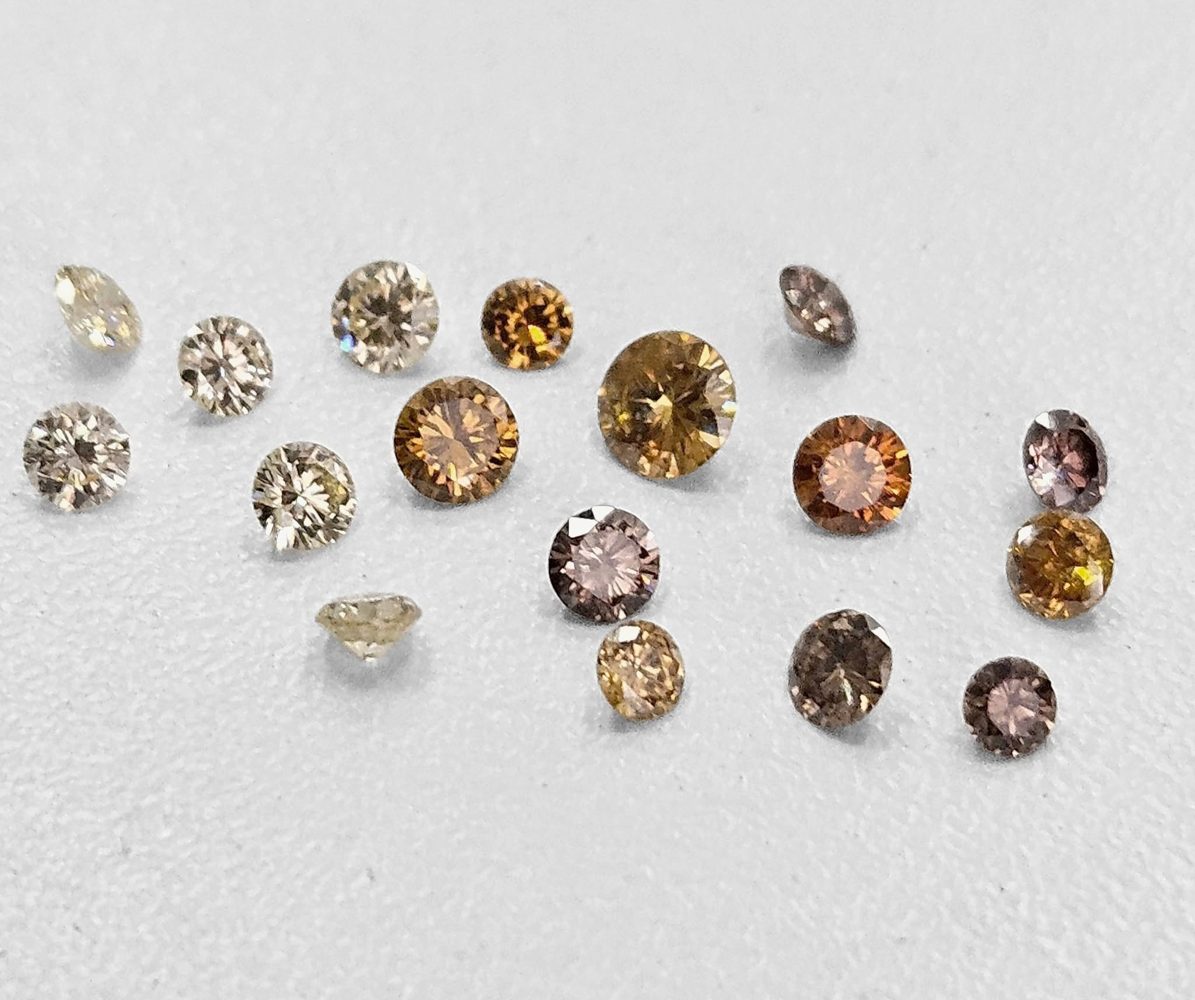
Choosing a champagne shade
Champagne is a trade description rather than a universal laboratory grade. GIA's warm-diamond guide discusses the term in relation to light brown diamonds. In a design conversation, it helps to go further: is the warmth a subtle tint, or do you want brown to be an obvious part of the ring?
Look at the group above in two passes. First notice which stones attract you. Then compare those favorites with the palest and deepest examples. This gives the conversation a useful boundary: how much color would be too little, and where would it start to feel too dark?
There is also a difference between wanting warmth throughout the ring and wanting a warm center that stands apart from its surroundings. Decide which effect interests you before choosing the side stones. Otherwise, it is easy to add details one at a time and discover that the finished composition feels busier than you intended.
The terminology and campaign background are covered in our champagne and Desert diamonds explainer. Here, the priority is turning the shade into a coherent ring.
Yellow gold, rose gold or white metal?
Treat metal choice as a design comparison. Yellow gold is one direction to explore for a warm overall palette; white metal can provide a more distinct frame; rose gold introduces another color to consider alongside the center. None is an automatic best choice for every champagne diamond.
The amount of visible metal matters as much as its color. A fine edge around the stone occupies little of the face-up view. A broad rim becomes a major part of the ring. Before deciding that you dislike a metal, check whether it is the metal's color or the width of that frame that bothers you.
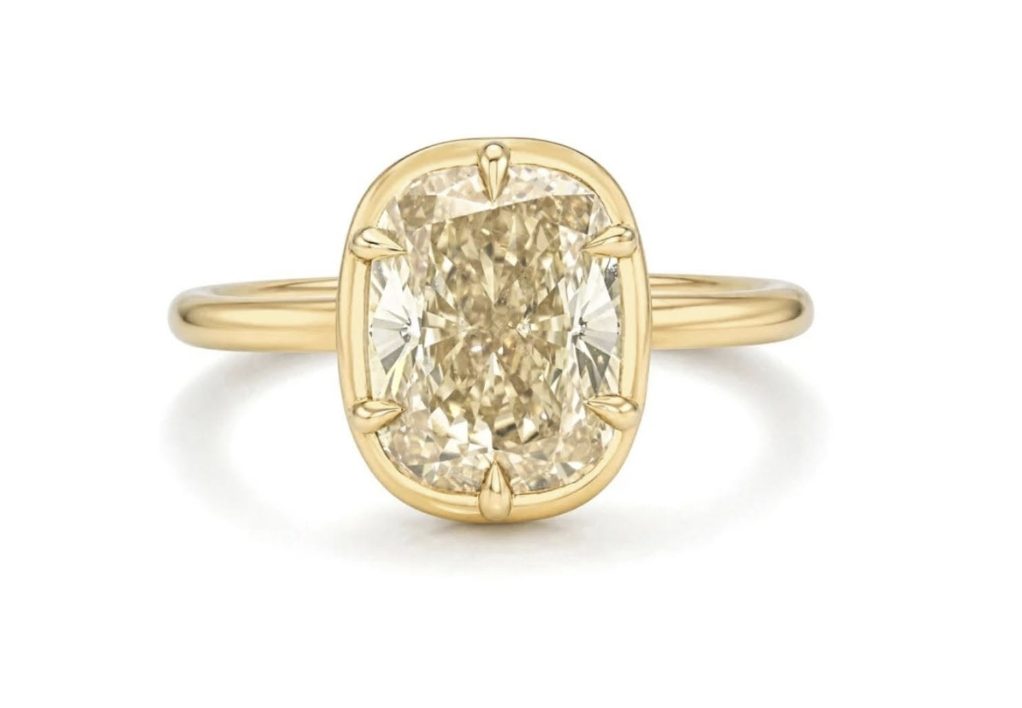
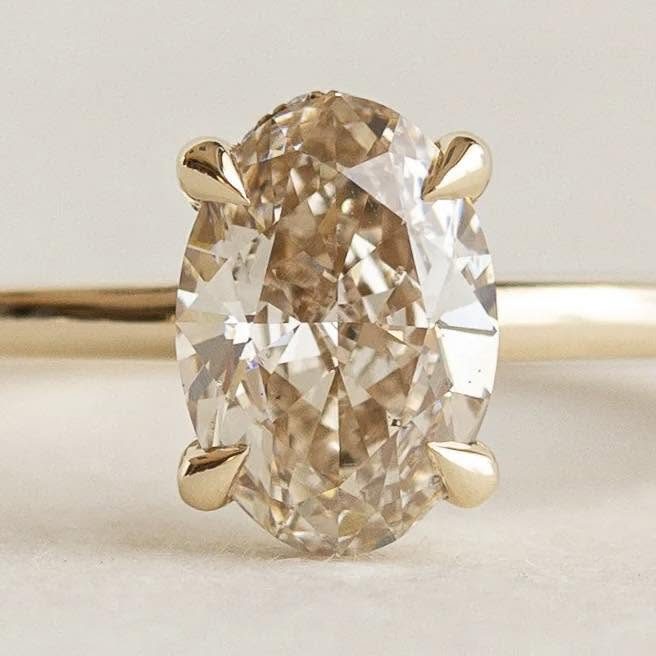
I would narrow this down by comparing a framed design with a more open one before getting absorbed in small decorative details. If you already have a wedding band, include it at this stage. A combination can feel quite different when a second band sits beside it.
Should a champagne diamond have white side stones?
White side stones are worth considering when you want a deliberate contrast around the center. A solitaire gives the center and metal more of the visual attention. Neither approach requires the champagne shade to be especially pale or deep.
Proportion is the next decision. Small accents, a substantial three-stone arrangement and a continuous halo each create a different outline. Ask to see the entire ring at a realistic scale. An enlarged detail can make a tiny accent feel much more prominent than it will be on your hand.
For a three-stone design, consider the relationship between all three outlines. Do the side stones continue the center's shape across the finger, or introduce a deliberate change of direction? If the center is the reason you chose the design, check that the surrounding detail still gives it the attention you want.
Shape and finger coverage
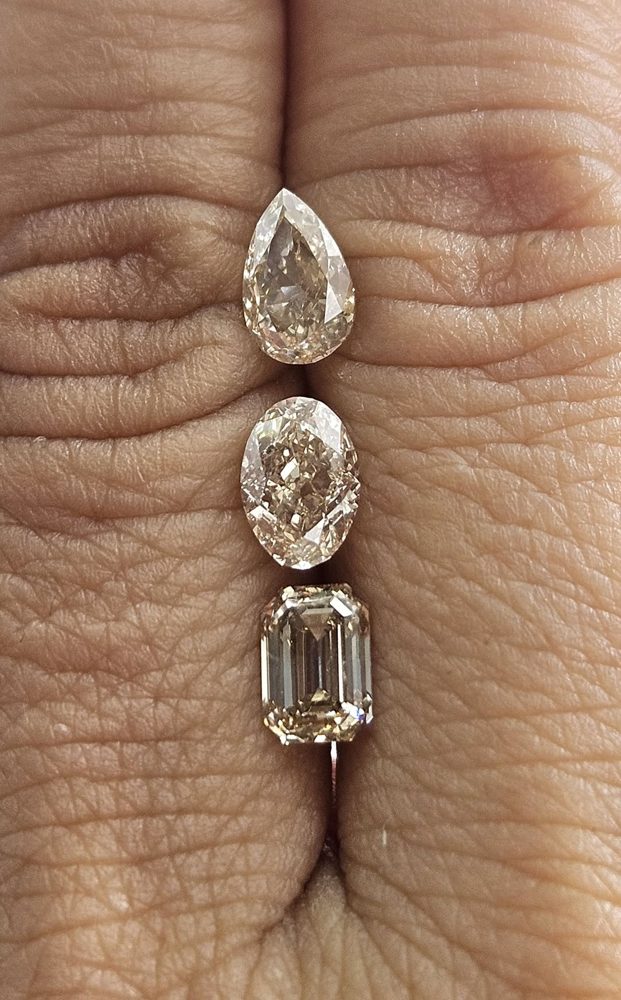
The on-hand view is useful because it brings the outline back into the decision. Notice where each shape is widest, how it ends, and how much length it occupies along the finger. That is different from sorting a list by carat weight.
A long, narrow center may be the feature you want to emphasize. A broader outline may suit a substantial band. Use the actual millimeter measurements when developing the setting, including depth: a face-up photograph cannot establish how low the finished ring can sit.
Pointed ends and the fit beside a wedding band also deserve a side-view discussion. These practical questions belong in the custom ring design process before the stone is committed to a particular setting.
Compare the stone before comparing the styling
For a final shortlist, separate the loose-stone comparison from the setting comparison. Begin with the candidates against a neutral background in similar lighting, then look at the preferred candidate with the proposed metal combination. This helps you work out which part of the presentation is driving your preference.
Ask for another ordinary lighting condition and gentle movement as well. If two suppliers provide very different photographs, request closer equivalents where possible. You don't need perfect studio matching to make progress, but you do need to recognize where the comparison is uneven.
Keep these details beside the images:
| Detail | What it contributes |
|---|---|
| Candidate reference and report, where supplied | Connects the images to the actual offer |
| Documented origin, color and treatment information | Identifies what is being offered beyond the trade name |
| Length, width and depth | Informs the ring's proportions and construction |
| Your preferred shade and proposed metal | Keeps the design decision visible alongside the specifications |
Natural and laboratory-grown options can both be part of the discussion. Warm appearance does not establish origin; our warm-colored lab-grown diamond guide covers that distinction. The natural versus lab-grown colored diamond comparison also separates origin from color treatment.
By this point, the brief should say more than “champagne solitaire.” It might call for a subtly warm oval, a narrow visible frame and room for an existing band. Or a distinctly brown center with contrasting side stones. Those are design directions we can evaluate against actual candidates.
Discuss a champagne diamond ring with Chloe. Include the shade, the setting detail you most want to keep, your budget range and timing.