Choosing a natural diamond for a ring designed from scratch
Choose a natural diamond with the finished ring in mind. Its report, cut, millimeter measurements and condition matter, but so do the setting height, band proportions, budget and the way you want to wear it. A beautiful loose stone still needs to work in your actual design.
If you know you want a natural diamond, we can start there.
You don't have to make a case for it. Maybe its natural origin is meaningful to you, maybe you have always pictured a particular shape, or maybe you just know that is the direction you want to explore. I work with natural and lab-grown diamonds, and my job is to help you make an informed choice within the brief you bring me.
What I don't want is for you to spend weeks choosing a stone and only then start asking whether the ring you wanted can be built around it.
Let's have those conversations together.
Should we choose the diamond or the setting first?
Start with a design direction, then choose the actual diamond and refine the setting around it.
You don't need a completed drawing. Tell me whether you want something low, whether you like a substantial band, whether a straight wedding band needs to sit beside it, and what shapes you keep saving. Those preferences help us evaluate candidates before you become attached to one.
If the stone is the part you are most excited about, that is fine too. We can start there while keeping the practical limits visible.
Our custom engagement ring process gives us room to consider the whole piece. A stock photograph of a setting doesn't tell us how it will work with a different stone's length, width and depth.
What does a natural diamond report tell us?
A laboratory report provides information about the individual diamond. It helps us compare documented characteristics, rather than relying on a retailer's description alone.
For a standard round brilliant in the D-to-Z color range, a GIA Diamond Grading Report includes an overall cut grade as well as other grading information. Its scope is different for other shapes. GIA explains the report and cut-grade distinction here.
I want us to read the actual document. Does it match the stone being offered? What measurements does it give? What does it say about the characteristics we are discussing, and what does it not tell us?
The report is useful evidence. It is not a photograph of how the finished ring will look on your hand, and it cannot decide whether you love the stone.
If you are considering a fancy-colored natural diamond, there is another conversation about color and color origin. Our natural versus lab-grown colored diamond guide separates those questions. This article focuses on choosing the stone and design together, rather than repeating that comparison.
Does an excellent grade mean I can stop comparing?
No. A grade can help narrow the options, but I still want us looking at the diamond.
GIA notes that diamonds within the same round-brilliant cut grade can have different visual characteristics. The grading framework is valuable; your own observation remains part of the decision. GIA's cut overview explains how the two work together.
With an oval, pear, marquise or emerald cut, don't assume a polish or symmetry grade is an overall assessment of its appearance. GIA's standard reports do not assign the same overall cut grade used for standard round brilliants to these fancy shapes. GIA's current cut-grade guide makes that distinction.
I would want to compare views and movement, not choose from the most flattering frozen frame. Do you like the outline? The proportions? The way the stone looks when it moves, rather than only when the light catches one part of it?
You don't need to learn a jeweler's entire vocabulary to tell me what you see.
Why do I care so much about millimeter measurements?
Carat is weight. Millimeter measurements help us understand how much space the stone will occupy in the ring.
I shared a photograph of two stones in our gemstone-sourcing guide: the smaller-looking stone on the left weighed 2.94ct, while the larger-looking one on the right weighed 2.84ct.
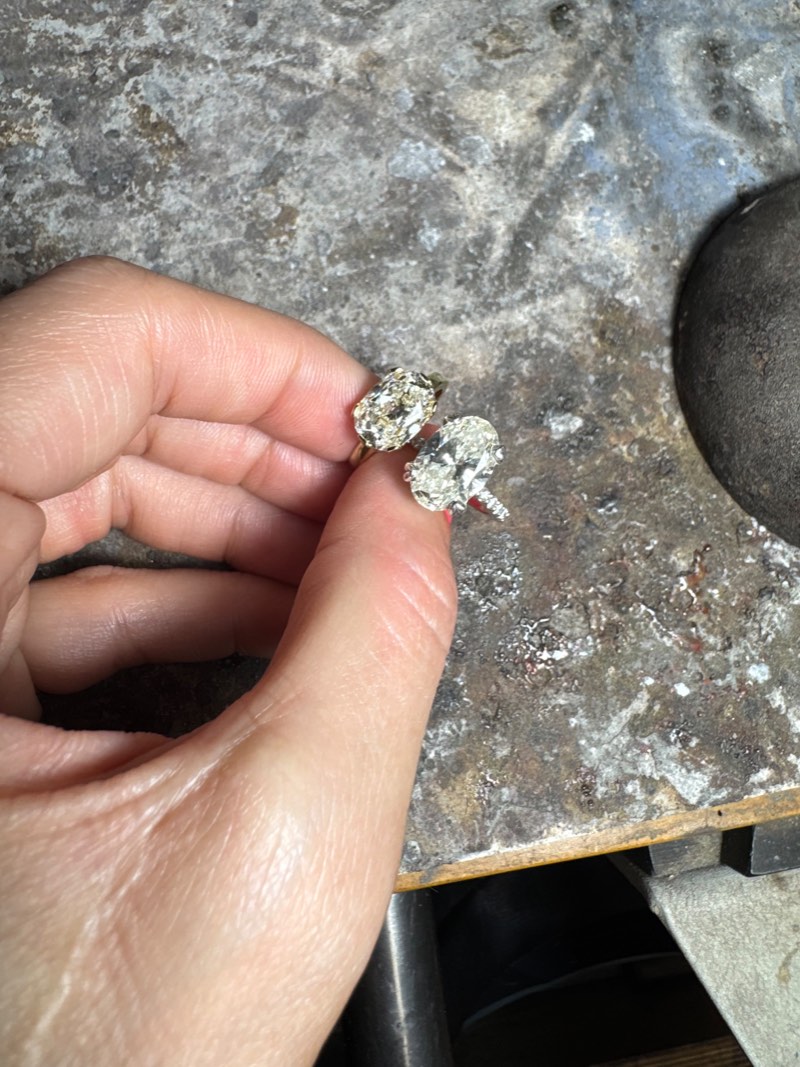
That example is about visible size. I am not presenting it as a documented comparison of two natural diamonds, because their origin isn't part of the evidence supplied for that photograph. But the point is relevant here: the heavier stone isn't automatically the one that looks larger.
For your ring, I want to compare the measurements, shape and proportions with your ring size and the design. A long oval and a round stone can occupy your hand very differently. Even two stones of the same shape and similar weight may have quite different outlines.
You can still want a particular carat weight. I just want us to look at the stones before the number makes the whole decision.
How do color and clarity fit into the choice?
They belong in the comparison alongside cut, appearance and the rest of the ring, rather than becoming a competition to collect the highest grades.
Tell me what you notice and what bothers you. Are you looking for a very crisp, colorless impression? Do you like some warmth? Is a characteristic visible to you in ordinary viewing, or are you reacting to an enlarged image on a screen?
Those are questions to explore with actual candidates. I wouldn't give you one universal color or clarity cutoff and tell you every natural diamond above it is right for you.
The setting matters to the overall impression too. We should think about the metal around the diamond, the amount of visible metal and any neighboring stones. I want to see the combination we are building, not treat the center stone as an isolated purchase.
What practical constraints should we discuss before buying?
Discuss height, protection, comfort and how another ring will sit beside it before making the final stone decision.
The depth underneath a diamond takes up space. A very low setting and a straight wedding band sitting tightly alongside it can create competing requirements, depending on the construction. That is worth working through in a side view.
A pointed shape brings its own setting questions. So does a broad stone across a small finger, or a design where you want very little visible metal. The answer has to come from the actual stone and proposed setting, not from the name of the shape alone.
A wax-model try-on can help you understand proportions and height before the finished ring is made. It won't reproduce the weight of the metal or the appearance of the diamond, but it can make the shape much easier to understand.
How should we divide the budget between the stone and the ring?
Start with a budget for the finished piece, then compare combinations that fit it.
If a candidate takes almost everything you intended to spend, we still need to ask what happens to the design around it. Maybe the stone is the priority and you love a simple setting. Maybe the setting is the thing that makes this ring yours, and spending more on a grade you don't particularly notice would mean giving up the detail you care about.
I would rather you understand that tradeoff before choosing.
Natural origin can be a meaningful preference. It is not, by itself, a promise of future resale value or a reason to ignore the rest of the purchase. I want you choosing a ring you understand and want to wear.
Where does the personal part come in?
It can be present from the first conversation, not added after the technical choices are finished.
In our marquise engagement ring upgrade, four hidden stones represented the couple and their two children. I am sharing that as an example of personal design, not as evidence of the center diamond's origin.
Maybe you want a hidden detail. Maybe the meaning is entirely in the natural diamond itself. Maybe you want a very clean ring with nothing extra added. We can give those preferences the same attention as the measurements.
For me, the goal is still that moment where you see the stone and know. THE stone. But I want the ring around it to make just as much sense.
Send me the shapes you love, your budget range and timeline, and anything you already know about the setting you want. We can start with that and work through the rest together.
Share your favorite shapes, budget range, timeline and setting ideas. Email Chloe.